
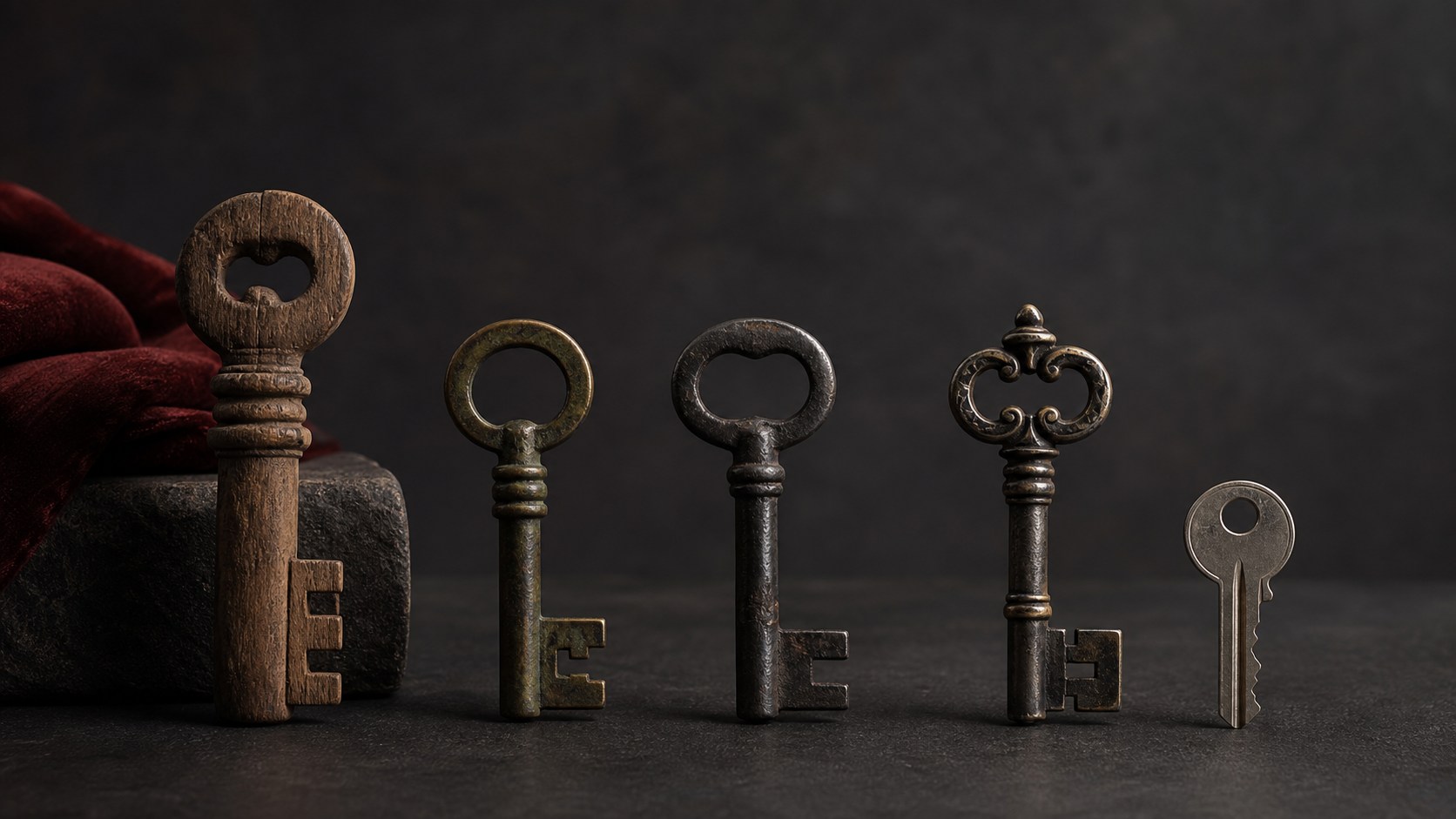
Why were the first keys so large?
Keys for wooden pin locks were much larger than the keys carried in a pocket today. Size was not decoration: the tool had to reach pins inside the lock and provide teeth at particular intervals.
The key entered through an opening below the bolt. Lifting it raised the pins to the required level, after which the bolt could be moved sideways by hand. The key did not rotate the lock; it temporarily cleared the obstructions within it.
From wood to bronze and iron
Advances in metalwork allowed smaller and more durable keys. Bronze could be cast, while iron could be forged and filed. The bow, shaft and working bit consequently took on distinct forms.
Smaller size did more than improve portability. A narrow keyway made direct access to the mechanism more difficult. As key and lock dimensions matched more closely, the maker's command of files, dies and measurement became increasingly important.
The Roman ring key
The Roman world used metal locks for doors, chests and small containers. Some keys were made in a form that could be worn on a finger. A bronze example from the third to fourth century in The Metropolitan Museum of Art demonstrates how a key could become a personal possession.
Not every ring key necessarily served the same purpose, but the form made access rights something that could be worn and displayed. The key was both a mechanical tool and a sign that its wearer had access to a particular place or object.
The long era of the bit key
From the medieval period into modern times, the most recognisable key was a long iron form with a round shaft and a cut bit at its end. Voids in the bit passed fixed wards inside the case, while the remaining part engaged the bolt.
The bow made the key easier to hold and gave the smith space for ornament. Keys for important buildings and chests could become visible parts of their objects through curling and symmetrical designs. The familiar silhouette of an 'old key' largely comes from this tradition.
How the key became a symbol of authority
Possessing a key meant carrying permission to enter a closed space. Ceremonial presentations of city keys and the use of keys in emblems grew from that meaning. The object joined trust, ownership and responsibility in a single form.
Expressions such as 'the key to the solution' extend this mechanical function into a metaphor. Because only the matching form opens the lock, the key became closely associated with knowledge, solutions and authority.
Industrial production standardised the key
A handmade key once belonged to a case prepared by one workshop. Factory production introduced repeatable lock dimensions, catalogued blank profiles and standard cuts. The outline related to a maker and lock family, while cut depths carried a particular combination.
Key duplication consequently became a separate service. A locksmith selected the correct blank and transferred the existing pattern on a cutting machine. The wrong profile would not enter; an incorrect depth would fail to place the pins at the required line.
The spread of the flat key
Pin-tumbler cylinders helped make the short flat key a daily object. Different depths along one or both edges positioned pins inside the cylinder. Its compact size allowed several keys to be carried together comfortably.
Grooved profiles, double-sided cuts and alternative surface geometries followed. The form changed, but the task did not: place only the matching mechanical arrangement in its release position.
Keys in the age of cards and phones
Magnetic cards, codes, remote controls and phone-based access have taken over some functions of the physical key. Metal keys nevertheless remain common in homes, workplaces, cabinets, machines and specialist locks because they provide direct mechanical authorisation without depending on power.
The small key used in an automatic-door or glass-balcony lock looks unlike its wooden ancestor, yet carries the same idea: movement is released not to everyone, but to the holder of the correct form. That simple function explains the key's long continuity.