
The origin of the Turkish word çilingir
The Turkish Language Association traces çilingir to the Persian cilānger and defines it as a key maker or locksmith. The word reflects a trade that included making locks, keys and small metal components long before emergency door opening became a familiar service.
The trade has no single starting date because locking devices developed in several places and materials. Museum collections preserve wooden pin mechanisms related to forms used in Egypt, while the spread of ironworking supported a much wider variety of metal locks.
The lock created a new kind of maker
Once a bolt could only be moved by a correctly shaped tool, lock and key became a matched pair. In wooden systems a key lifted pins inside the body; in metal locks its bit passed fixed obstructions and moved the bolt.
As each lock was handmade, its key was normally produced by the same workshop. The early locksmith combined the roles of designer, blacksmith, repairer and installer. A worn spring, pin or bolt often had to be filed and fitted again rather than replaced from stock.
Lockmaking in the medieval workshop
The growth of towns, stores, workshops and private dwellings increased demand for locks. Forged padlocks and door locks could display a maker's skill as well as protect property; elaborate escutcheons and key bows appeared in prestigious buildings and objects.
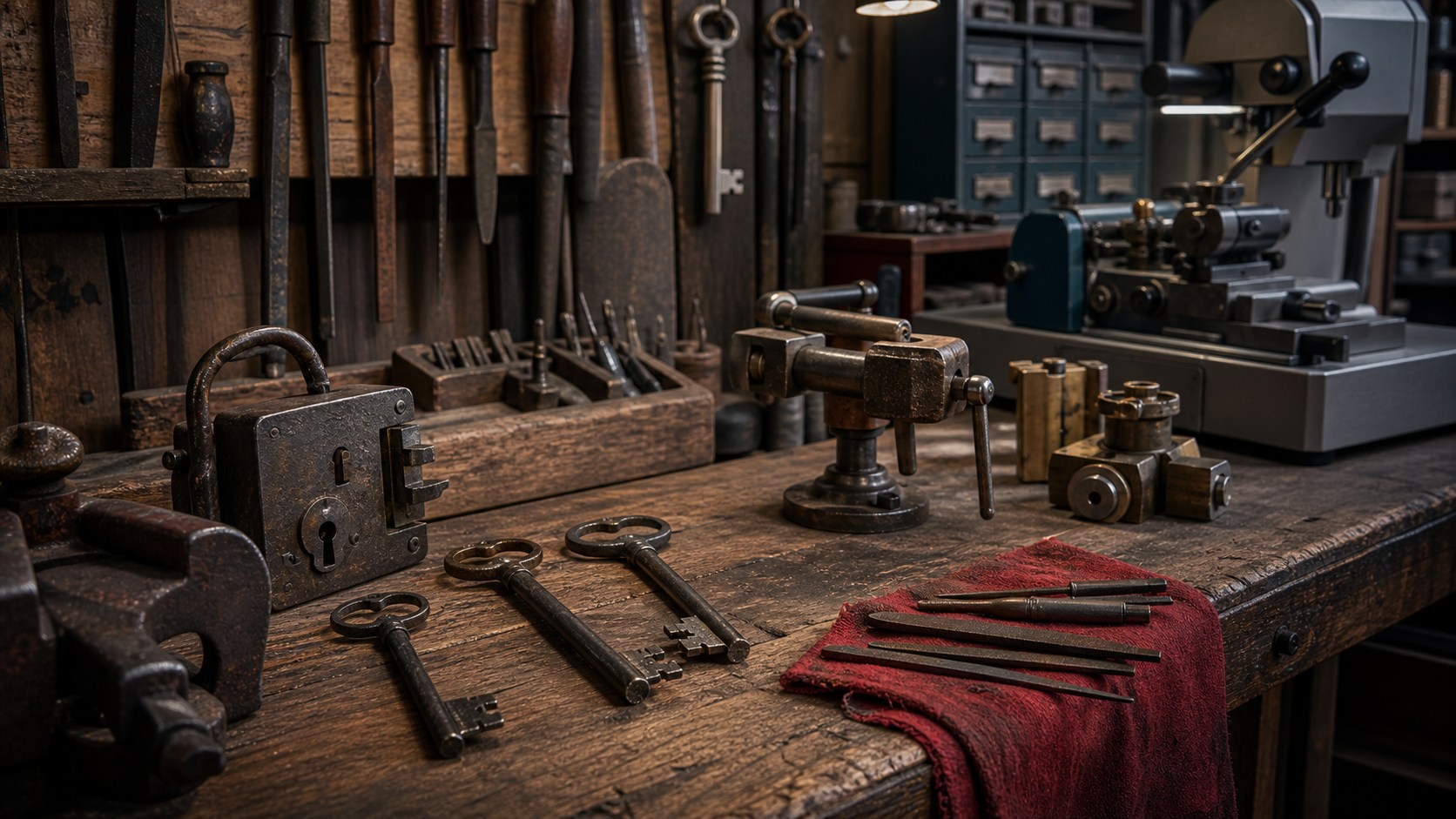
Warded locks, opened by a bit key cut to pass obstructions inside the case, remained common for centuries. Locksmiths shaped keys with files and chisels, fitted cases to doors and learned to resolve a jammed mechanism without unnecessary damage. Opening tools grew from the same mechanical understanding, but legitimate use depended on authorisation and trust.
Work beyond the front door
A locksmith's workshop once handled far more than duplicate keys. Artisans repaired chest and cabinet locks, recreated lost keys and remade small metal parts. Their ability to file precise mating surfaces was valuable in the repair of other mechanisms as well.
The boundary between blacksmith and locksmith was therefore less rigid than it is today. Blacksmiths formed larger work; locksmiths gradually specialised in small moving components that had to meet accurately inside a case.
Industrialisation changes the bench
Standard dimensions, machine tools and serial production transformed lockmaking during the Industrial Revolution. Factories could supply repeatable cases and key blanks. Manufacture moved away from the individual bench, while installation, servicing, duplication and fault finding became more important.
Improved metallurgy produced stronger and more precise components. It did not remove the locksmith; it changed the required knowledge. A practitioner now had to recognise factory-made mechanisms, select the correct blank and understand tolerances as well as shape metal.
The cylinder lock and the flat key
Nineteenth-century pin-tumbler cylinder designs helped make smaller, portable flat keys familiar. Linus Yale Jr.'s patents of 1861 and 1865 are important industrial-age examples of spring-loaded pins arranged around a rotating cylinder.
In the twentieth century, key-cutting machines, catalogued profiles and manufactured blanks became standard equipment. Duplication became faster, but the number of brands, profiles and lock types that a competent locksmith needed to identify also grew.
Professional organisation in Türkiye
Efforts to organise key cutters and locksmiths in Türkiye took clearer form in the early 1990s. According to the history published by the Istanbul Chamber of Key Cutters and Locksmiths, practitioners seeking common solutions and a lawful professional framework formed an association in February 1991.
Work toward chamber status began in 1994. Organisation addressed not only trade issues but also identity, registration, training and public trust, all essential in a profession that gives direct access to the most sensitive point of a home or workplace.
New systems, the same responsibility
Most locks, key blanks and lock components are now produced industrially. Diagnosing a fault, extracting a broken component, changing a lock and working without damaging the door still require field knowledge. Electronic access control adds new systems to the locksmith's mechanical foundation.
The central duty remains protection of people and property. Customers should verify identity, business and professional registration, while a locksmith should confirm authority before opening a door. The trade belongs to skilled practitioners who use their knowledge with accountability—not simply to anyone who owns the tools.