
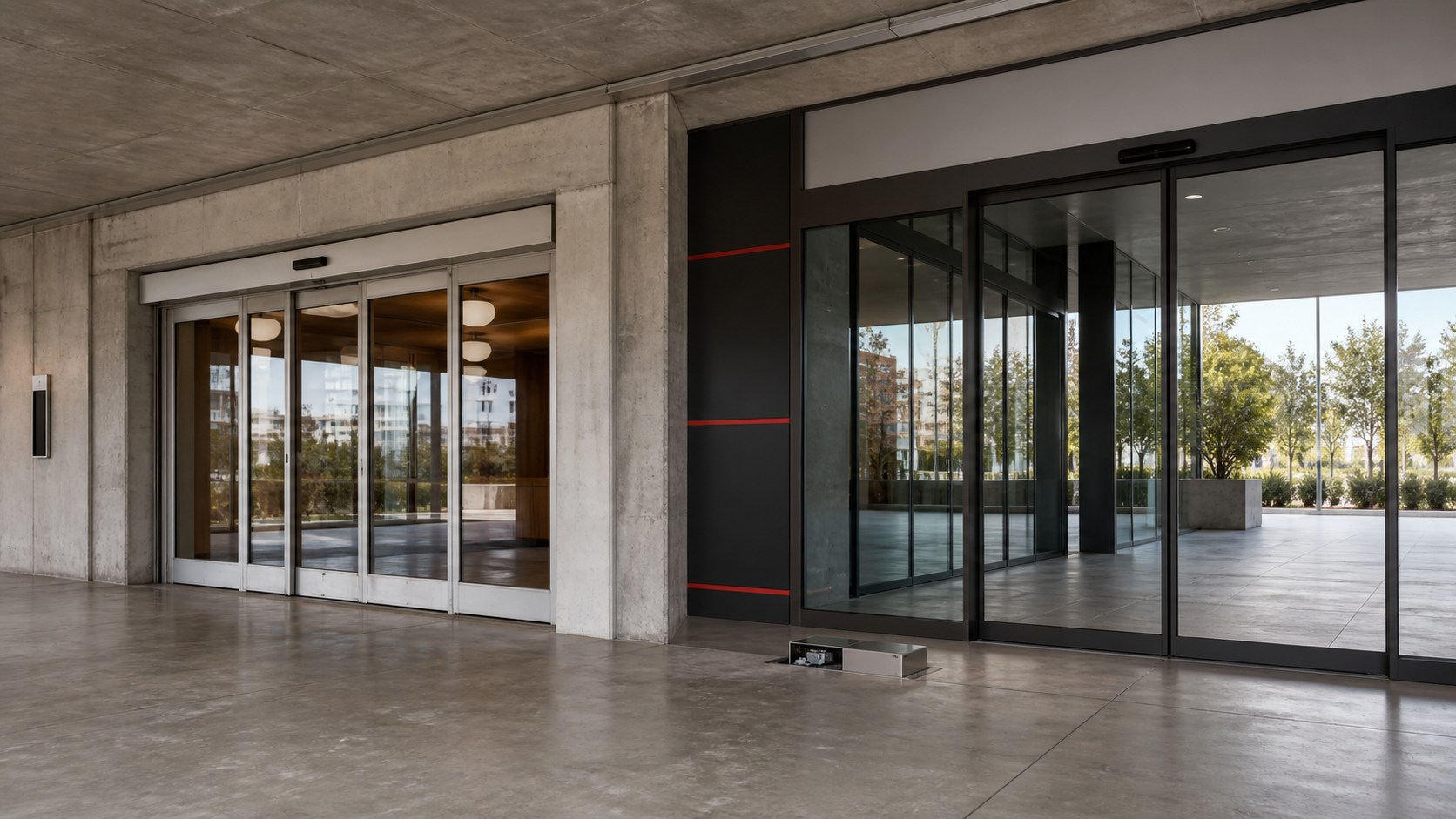
The modern sliding entrance takes shape
Self-moving doors are not entirely modern. Ancient ceremonial mechanisms used air, water and counterweights, but they were fundamentally different from today's pedestrian entrances.
The modern story became clearer in Corpus Christi, Texas, during the mid-1950s. Lew Hewitt and Dee Horton looked for an alternative to swing doors that were difficult to use in strong winds. Horton Automatics records that it developed the first automatic sliding door sold in America in 1960.
From pressure mats to electronic sensing
Early commercial installations commonly used a pressure mat in front of the entrance. A person's weight triggered the opening cycle, making the activation area a visible part of the doorway.
Electronic sensing later introduced microwave motion detectors, passive infrared devices and infrared beams across the threshold. Patents from the early 1990s describe separate approach and threshold zones. Detection was no longer only about opening the door; it also helped keep the passage clear while a person remained in its path.
Why Türkiye calls it a 'photocell door'
In Türkiye, the everyday term is fotoselli kapı—literally, photocell door. A current system may in fact combine several methods for motion, presence and threshold detection. The familiar name describes the experience of a door responding to an unseen sensor rather than one specific component.
The header contains the operator, control unit, belt and carriages, while sensors monitor the approach and passage. The glass leaves move laterally on a track, avoiding the swing arc of a conventional door and making the format useful at busy entrances.
From the shop entrance to urban life
Retail was one of the first strong applications. Shoppers carrying bags could enter without reaching for a handle, the glass frontage remained visually continuous, and the leaves did not swing into the circulation area.
Hospitals, hotels, airports and office buildings later adopted the same format. The door became an architectural component that manages pedestrian flow rather than simply a convenience device. Opening speed, hold-open time and detection zones came to be considered in relation to the use of each building.
Safety became as important as movement
Early systems concentrated on detecting an approaching person and initiating an opening cycle. Wider use placed equal importance on monitoring the closing path, recognising something at the threshold and behaving predictably when a component failed.
This is why approach and threshold sensors perform different tasks. One requests opening; the other observes the area through which the leaves travel. A modern automatic entrance is not a single invisible eye but a coordinated arrangement of a motor, controller and several detection zones.
Automation did not remove the lock
Automatic operation changed how the entrance moves, but it did not remove the need to hold closed leaves physically after business hours. The operator manages movement; a mechanical lock can provide a separate connection between the leaf and the floor.
A floor-level automatic sliding door lock is therefore not opposed to automation. It completes the closed state while keeping bulky hardware away from the main glass surface. Electronic access and mechanical restraint simply perform different jobs at the same entrance.
The automatic entrance as a complete system
A current sliding entrance combines glass and aluminium leaves, header-mounted carriages, an electric motor, drive belt, controller and sensors in one cycle. It detects approach, accelerates the leaf, waits in the open position and closes in a controlled manner once the passage is clear.
Each part answers a different need. Sensors observe, the controller decides, the motor creates movement, the track guides it and the mechanical lock holds the leaf after hours. The history of the automatic door is therefore the history of these parts learning to work together.